Worship Online: ongoing application ownership
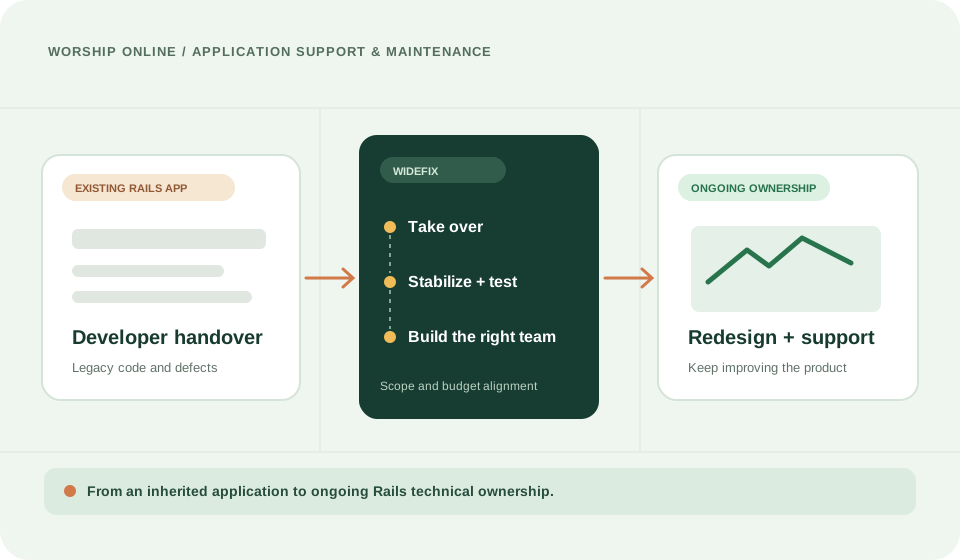
Took over after a developer handover, fixed defects, expanded automated testing and continued maintenance and feature delivery while coordinating specialists around the budget.
Read the case study
Services for existing applications
For founders and teams running an existing Rails product: resolve production problems, keep dependencies maintained and deliver the next useful change. WideFix takes technical ownership of inherited applications, with scope, support hours and budget agreed before work begins.
Maintenance budget
At $3,000/month, about 58 shared team hours cover maintenance and scoped feature work.
Compare budgets and coverageClient work and independent reviews
Took over after a developer handover, fixed defects, expanded automated testing and continued maintenance and feature delivery while coordinating specialists around the budget.
Read the case studyRecovered a stalled DelayedJob queue, cleared the stuck backlog and repaired third-party integrations. Read the case for the reported outcomes and measurement limits.
Read the case studyRead individual client engagements and feedback on delivery. Clutch profile checked November 7, 2026.
Read the reviewsBring your next business priority and the problems affecting customers. We agree the initial review scope and price before work begins. The review needs repository and dependency information, deployment documentation and relevant error logs; hosting or monitoring access is agreed as needed. Use scoped access rather than sharing credentials in an enquiry.
Receive one prioritized backlog covering product changes and application risks. Agree the first outcome, acceptance checks and the decisions that need your input.
Document included systems, technical contacts, support hours, spending limits and escalation arrangements. Identify access or monitoring gaps before relying on the support process. Keep a shared record of repositories, releases and integrations so teammates can find what they need without repeatedly interrupting the original developer.
Carry the agreed change through investigation, implementation and release. Receive a summary of checks, observed results and remaining risks. Select a suitable production observation period and business metric together where relevant.
Diagnose bugs, failed jobs and integration errors. Improve monitoring and error handling so recurring incidents become visible and actionable.
Review Ruby, Rails and gem updates, address security fixes and add regression coverage for important workflows. Keep deployment and rollback instructions usable.
Deliver features, APIs and integration changes alongside maintenance. Use one prioritized backlog so product delivery and application health compete openly for the same budget.
For a small Rails application, discuss a $3,000 monthly budget with a named lead and a second engineer for continuity. At the published starting rates and 7% architect share, this is about 58 shared team hours a month, roughly 13 a week. Confirm the two engineers, role split and absence arrangements before work begins.
The lead investigates problems, organizes the backlog and carries agreed changes through implementation, testing and release. Andrei Kaleshka supports planning, scope and technical decisions. You bring business priorities without having to manage the engineers or write technical tickets.
Allocate some of the same hours to reviews and shared tasks so a second engineer understands the application, has appropriate access and can use the deployment notes. Define who covers an absence and when they are available; two names alone do not establish coverage.
Provide product context and access during onboarding, then agree priorities and receive a concise weekly update on progress, risks and hours. We handle routine technical coordination within the scope. You approve business trade-offs and extra spending; no fixed amount of founder time is promised.
Availability and response targets are agreed before support begins, based on your product needs and the engagement scope.
Agree a recurring allocation for fixes, dependency work and monitoring follow-up. Define included systems, the backlog and how unused or additional time is handled.
Reserve capacity for both support and new features. Review priorities regularly and agree a budget for the next delivery period.
Agree support hours, time zone, communication channel, severity levels, acknowledgement targets and escalation contacts. Response and resolution are separate expectations; out-of-hours coverage requires an explicit arrangement.
Pricing
WideFix prices team capacity in hours, in USD. Senior developers start from $50 per hour and a solutions architect is $80 per hour. The monthly plans include a 7% architect share; the weekly examples use 12% at 25 hours and 10% at 40 hours. Architect time is included in the stated hours and costs.
| Monthly budget | Shared team capacity | Work that can fit | Team and incident coverage |
|---|---|---|---|
| $1,500 a month See $1,500 a month in the calculator | About 29 team hours a month, roughly 7 a week, including architect time. These are total team hours, not hours per person. | Routine upkeep for a healthy application: dependency review, monitoring follow-up and small fixes. Large upgrades or redesigns may need a separate milestone or larger budget. | Agree the engineer allocation and responsibilities before work begins. Support windows, incident coverage and response targets are agreed separately; continuous out-of-hours coverage is not included by default. |
| $3,000 a month See $3,000 a month in the calculator | About 58 team hours a month, roughly 13 a week, including architect time. These are total team hours, not hours per person. | Maintenance and scoped feature work share the allocation. Each change is estimated against your application before we agree priorities. Large upgrades or redesigns may need a separate milestone or larger budget. | A named lead and second engineer arrangement is available by agreement, including allocation and absence cover. Support windows, incident coverage and response targets are agreed separately; continuous out-of-hours coverage is not included by default. |
Planning, investigation, reviews, coordination, testing, releases and keeping a second engineer familiar all use the same allocation. These budgets buy part-time capacity, not two dedicated engineers.
About $5,807 to $9,187 a month
Upkeep with planned improvements and feature work in one backlog. The initial assessment is priced case by case.
See 25 hours a week in the calculatorThese are planning figures, not quotes. Prices are current as of November 2026 and may change; rates are agreed before work begins. The final scope depends on your application's condition, support needs and development priorities.
Yes. We start with the existing code, access and business workflows. Missing documentation or an unavailable previous developer changes the investigation needed; we agree that scope before ongoing support.
We assess compatibility, security exposure and the upgrade path. Maintenance cannot restore vendor security support to an unsupported version. Agree immediate mitigations and a staged upgrade separately where needed.
Choose maintenance only or maintenance plus feature delivery. Agree recurring capacity and spending limits; extra hours need approval, and unused hours are credited proportionally. Starting prices and plan terms are in the pricing section above.
Andrei Kaleshka leads technical direction and delivery. Agree workstream owners, escalation contacts and absence cover at onboarding. Shared deployment notes and business-owned accounts let another engineer get oriented; cover depends on the agreed team and availability.
Define included systems, dependency review and incident work in the agreement. Confirm support hours and time zone, acknowledgement targets and escalation. An acknowledgement is not a resolution deadline. Continuous out-of-hours coverage and a full security audit are not implied by routine maintenance.
Agree notice, any remaining work and handover scope before starting. Keep source code, hosting and integration accounts under business control. Plan transfer of deployment notes, access, known risks and outstanding priorities to your next engineer.
Experience you can inspect
Our open-source tool tracks migrations and helps keep local Rails databases aligned across Git branches.
Explore the migration toolClutch’s profile shows a 4.9/5 overall rating across 13 reviews, checked November 7, 2026. Read individual engagements and client feedback.
See verified client feedbackWideFix founder Andrei Kaleshka leads technical delivery. Clutch lists the company as founded in 2014. Read the original sources for his published book, recorded talk and open-source work.
See the evidence and sourcesClient feedback
Read attributed client reviews on Clutch, including the engagement context and feedback on delivery.
“WideFix really takes ownership of the process and is not just a group of robots.”
Further reading
Engineering article
Compare published offers, entry steps, continuity and coverage, with a production handover checklist.
Read the engineering articleEngineering article
Separate onboarding, recurring upkeep, incidents and feature delivery before comparing quotes.
Read the engineering articleExplore the next step
Explore focused services to carry your upgrade plan forward.
Related service
Plan and implement a focused upgrade alongside ongoing maintenance, with compatibility fixes, workflow checks and agreed release milestones.
Explore the serviceRelated service
Identify compatibility blockers, critical workflow checks and a first delivery milestone before committing to an upgrade.
Explore the serviceRelated service
Plan dependency upgrades, strengthen tests and modernize an aging application in manageable stages.
Explore the serviceRelated service
Diagnose recurring failures, stabilize production and document a recovery plan.
Explore the serviceRelated service
Connect your technical roadmap, architecture decisions and delivery team with business priorities.
Explore the serviceEngineering article
Read our account of upgrading Ruby and Rails, including compatibility issues and lessons from the process.
Read the engineering articleSend your Ruby and Rails versions, hosting provider, current problem and desired support. Include your time zone and any business deadline so we can discuss access, assessment scope and the first delivery milestone.
