- What does a Rails maintenance team cost?
- What if my budget is $1,500 a month?
- What if my budget is $3,000 a month?
- What can larger capacity cover?
- Separate four parts of the budget
- Two illustrative scopes
- Turn the scope into a budget
- How does capacity-based pricing compare with other options?
- What can delayed maintenance cost?
- Questions to settle before signing
- Pricing FAQ
- Who you will work with
- Examples from our work
- Agree on the next step
A monthly Rails maintenance price is useful only when you know what it buys. Two proposals can use the same word for very different work: dependency reviews in one, production support and feature delivery in another.
When taking over an existing application, I would separate the initial investigation from recurring upkeep and planned changes. The investigation can reveal missing access, unsupported dependencies or a fragile deployment that makes the original estimate incomplete.
This guide explains how to scope a Rails maintenance budget, including how WideFix prices team capacity. Plans start at $1,500 a month, about 30 developer hours at the $50 starting rate. The final scope depends on your application’s condition, support requirements and development priorities.
What does a Rails maintenance team cost?
WideFix prices team capacity, and all prices here are in USD. Senior developers start from $50 per hour. A solutions architect is $80 per hour and joins for planning, reviews and architecture decisions rather than for every hour of the week. Most of the hours go to a senior developer. Capacity ranges from a small monthly plan to larger engagements of 25 to 40 team hours a week.
| Budget | Team hours | Illustrative split | What it can cover |
|---|---|---|---|
| $1,500 a month | About 30 a month (7 a week) | Mostly developer time | Routine upkeep: dependency review, monitoring follow-up and small fixes |
| $3,000 a month | About 60 a month (14 a week) | Mostly developer time | Upkeep plus mid-size features, depending on the application |
| About $5,807 a month ($1,340 a week) | 25 a week (about 108 a month) | 22 developer hours + 3 architect hours | Upkeep with room for planned improvements |
| About $9,187 a month ($2,120 a week) | 40 a week (about 173 a month) | 36 developer hours + 4 architect hours | Upkeep and feature work in one backlog |
Hours use the $50 developer and $80 architect rates. Each architect hour costs 1.6 developer hours, so more architect time means fewer hours within the same budget. Weekly engagements are converted to monthly figures using 52 ÷ 12 weeks. These splits are examples, not packages.
To see these figures with your own numbers, open the team cost calculator with $1,500 a month, $3,000 a month, 25 hours a week or 40 hours a week. It starts from these rates and lets you change the budget, the architect share and every rate. The calculator counts architect time inside the budget, so at a 7% architect share $1,500 gives 28.8 team hours and $3,000 gives 57.6, slightly below the developer-only figures of 30 and 60 above. Its result is a planning estimate, not a quote.
We agree the weekly or monthly capacity and the split with you before work starts. Work beyond that capacity needs your approval. Planning, investigation, testing and deployment count toward the hours. Unused hours are credited as a proportional discount on your next invoice. On monthly plans up to $3,000, the initial assessment is included in the first month’s hours. For engagements of 25 to 40 hours a week, it is priced case by case, because it depends on access, documentation and the state of the code.
Whether this capacity fits your application depends on its condition, integrations and expected workload. We review those factors with you, agree on priorities and define a realistic scope before starting.
What if my budget is $1,500 a month?
A smaller budget can still fund useful maintenance. At the $50 starting developer rate, $1,500 buys about 30 developer hours a month, roughly 7 hours a week. Architect time comes out of the same budget: two architect hours cost $160, leaving 26.8 developer hours.
What the $1,500 plan includes:
- The initial assessment, which uses part of the first month’s hours. How much depends on your application.
- A proportional credit on your next invoice for unused hours.
- Support hours, incident coverage and notice set out in your agreement before work begins. Continuous out-of-hours coverage is not implied.
- The option to stage an upgrade if your application runs on a Rails version that no longer receives security fixes. We can work in small steps within the monthly hours; how many steps it takes depends on how far behind the application is, and a step that will not fit gets its own estimate.
That capacity can cover routine upkeep for a healthy application: dependency review, monitoring follow-up and small fixes. It is not enough for heavy feature development or a full redesign of the application. Those need a larger budget or a staged plan.
With a small budget, I would spend the hours in this order:
- Make sure a release is reproducible and that someone has the access needed to deploy it.
- Review security updates and dependencies that put the application at risk.
- Follow up on errors and monitoring alerts that your customers are likely to notice.
- Fix small problems in the workflows your business uses every day.
These are starting priorities, not a fixed task list. A production incident may displace planned work within the same budget; extra hours still need your approval. Tell us which workflow matters most to your business so we can prioritize accordingly.
To see how the hours change with your own architect share or rates, open the calculator with $1,500 a month.
Tell us what you want to improve and your monthly budget. We’ll help you turn both into a realistic plan.
What if my budget is $3,000 a month?
At the $50 starting developer rate, $3,000 buys about 60 developer hours a month. With a 7% architect share, that is about 4 architect hours and 53.6 developer hours. This still leaves room to add a mid-size feature alongside upkeep, instead of limiting the work to small fixes. What fits depends on your application, so we estimate a feature against your codebase, including testing and deployment, before agreeing what to deliver.
For a real example of a feature added to an existing product, see how we expanded Costa Del Home’s property-management CRM to support multiple managers per property. That showcase is not a $3,000 package or evidence of how many hours it took.
Urgent maintenance comes out of the same monthly hours. If a feature needs more than the budget allows, extra hours need your approval before we go over.
Open the calculator with $3,000 a month to see the hours at your own architect share and rates.
What can larger capacity cover?
At larger weekly capacity, and depending on the application, a few weeks of work could cover moving to another server, investigating and fixing a performance bottleneck, building a feature, or completing a defined stage of a larger upgrade or redesign.
We agree on how urgent maintenance affects planned feature work and explain when a larger task needs to span multiple months.
Larger applications, wider support coverage or more ambitious development plans may need more than 40 hours a week or additional specialists. We can assemble a broader team and adjust capacity as your needs grow. Our Worship Online maintenance showcase explains how we coordinated specialist expertise around the product’s needs and budget.
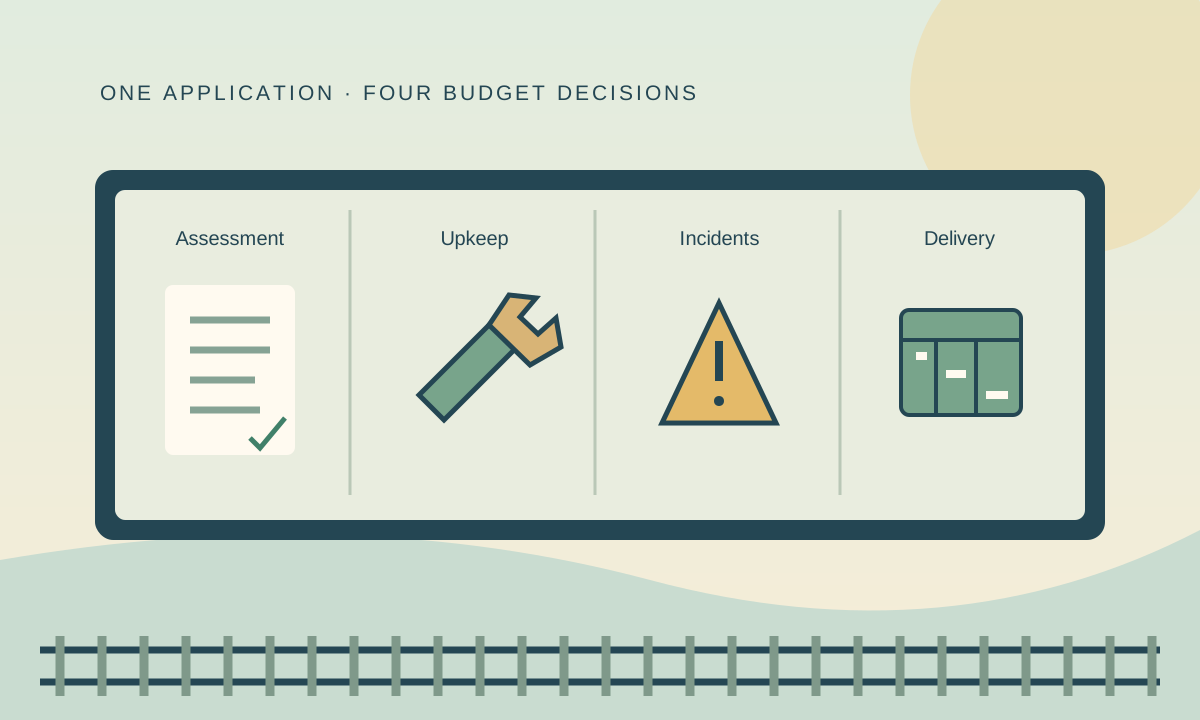
Separate four parts of the budget
| Budget item | What to define | What can change the estimate |
|---|---|---|
| Initial assessment and handover | Repositories, hosting, dependencies, critical workflows, tests, deployment and known incidents | Missing access, absent previous developer, undocumented integrations and inability to reproduce production behavior |
| Recurring upkeep | Dependency review, security triage, small fixes, monitoring follow-up and reporting | Support status, release frequency, error volume and the effort needed to validate a change |
| Incident capacity | Coverage window, severity, acknowledgement target, escalation and investigation allowance | Unclear ownership, missing logs, failed integrations and third-party response times |
| Planned delivery | Features, substantial upgrades, infrastructure changes and performance projects | Compatibility blockers, data changes, acceptance criteria and coordination with other teams |
Keep hosting, paid monitoring, third-party subscriptions and specialist audits visible as separate costs. State whether they are included in a quote. A security dependency review does not by itself constitute a full security audit.
Two illustrative scopes
Routine maintenance for a stable product
Assume one Rails application, working deployment access, usable tests, documented integrations and no unresolved production incident. The business needs dependency review, monitoring follow-up and occasional small fixes.
Ask for a recurring allocation with a prioritized backlog and a spending ceiling. For illustration, a $1,500 monthly plan buys about 30 developer hours at $50/hour. Specify how often dependencies and alerts are reviewed, what counts as a small fix and what happens to unused time. A major framework upgrade or a new integration needs its own estimate if it will not fit the allocation, although a long upgrade can be staged in smaller steps.
The useful output is a record of completed work, hours used, remaining risks and the next priority. If fewer hours are needed, the unused portion becomes a credit on the next invoice.
Maintenance plus product development after takeover
Assume an inherited SaaS whose original developer is unavailable, with incomplete runbooks and a backlog of customer requests. The first work is to establish access, make a release reproducible and identify critical workflow checks.
Quote that assessment separately. Then agree capacity for upkeep and features in one backlog, with explicit approval for work beyond the budget. For illustration, 40 team hours a week with 32 developer hours and 8 architect hours is $2,240 a week, or about $9,707 a month. The architect share is higher than in a stable product because the early weeks involve more decisions about structure, risk and priorities. Decide how a production incident changes feature priorities and how that decision is reported.
This scope needs technical ownership as well as implementation. Ask who makes architecture decisions, who can cover an absence and what documentation lets another engineer resume work. Do not assume those responsibilities are included simply because a proposal lists developer hours.
Turn the scope into a budget
For an hourly proposal, use developer hours × developer rate + architect hours × architect rate, then add any separately priced assessment and known external costs. For a fixed monthly proposal, list included tasks and limits, setup fees, overage rules and exclusions. Keep a reserve only if you agree what triggers its use; it should not authorize unlimited extra work.
Ask each provider to price the same assumptions. If one proposal includes a major Rails upgrade and another excludes it, comparing monthly totals will mislead you. If capacity is flexible, agree how changes are requested and when the new budget takes effect.
Avoid equating acknowledgement with resolution. An engineer can acknowledge an incident before knowing whether the cause is application code, a third-party API or infrastructure. A resolution promise needs a much more specific scope than an acknowledgement target.
How does capacity-based pricing compare with other options?
Hiring, freelancers, fixed-tier retainers and capacity-based pricing solve different problems. The first two rows below reflect my experience, not measured market data.
| Option | What you control | What to check |
|---|---|---|
| In-house hire | Daily priorities and context | Recruiting time, the full cost of employment and what happens when that person is unavailable or leaves |
| Freelancer | Flexible hours and direct communication | Availability, cover for absence and who else understands the application |
| Fixed-tier retainer | A predictable monthly fee | Included hours, support limits and what falls outside the tier |
| Capacity-based plan | Hours matched to your priorities, with a developer and an architect as needed | You must agree priorities and approve work beyond the agreed capacity |
As of November 12, 2026, Rumrail lists Rails maintenance plans at $1,795 per month plus a one-time $995 setup fee, $3,500 per month and from $5,500 per month. Its entry tier lists limited support hours without stating a number.
WideFix’s $1,500 and $3,000 monthly budgets are lower than those first two listed fees, but that does not establish equivalent coverage or better value. Our illustrative 25- and 40-hour weekly teams cost about $5,807 and $9,187 per month respectively. Compare included hours, responsibilities, setup costs and coverage, not only the monthly total. The maintenance company comparison can help you ask the same questions of each provider.
What can delayed maintenance cost?
The Rails maintenance policy normally gives each minor release series bug fixes for one year and security fixes for two years after its first release. Check the policy for your release’s support dates and any extensions. After support ends, you cannot rely on new official releases to fix its bugs and security issues; you need an upgrade or an explicitly maintained alternative. In my experience, the upgrade also grows more expensive the longer it waits.
Staging an upgrade helps control spending, but it does not restore official support while the old version remains in production. We assess the immediate risks as well as the upgrade work.
Not every saving is about security. When we moved Costa Del Home from Heroku to AWS with Dokku, its monthly hosting bill fell from €400 to €50, which is €4,200 a year at those prices. That result came from one project’s circumstances and is not a guarantee for yours.
Questions to settle before signing
- Which application, background workers and integrations are included?
- What access and documentation must the business provide?
- What does the assessment produce, and when do we agree the recurring scope?
- How do planning, coordination and specialist time count toward the allocation?
- Which hours and time zone are covered, and what happens outside that window?
- Who approves extra work, and when is an estimate revised?
- How do unused capacity, incidents and feature requests affect the budget?
- Who owns technical decisions, and what absence cover is actually available?
- What notice and handover work apply when the engagement ends?
Pricing FAQ
How much does Rails maintenance cost at WideFix?
Plans start at $1,500 a month, about 30 developer hours at the $50 starting rate. Architect time is $80 per hour and comes out of the same budget. The illustrative 25- and 40-hour weekly teams above cost about $5,807 and $9,187 a month. Your agreed rates and role split determine the final figure. Try your own budget or team in the team cost calculator.
What can I get for $1,500 a month?
About 30 developer hours at the $50 starting rate. This can cover routine upkeep. Heavy feature development or a redesign needs more capacity or a staged plan. See $1,500 a month in the calculator.
What can I get for $3,000 a month?
About 60 developer hours at the $50 starting rate. That can cover routine upkeep and mid-size features, depending on your application. See $3,000 a month in the calculator.
Do I pay for an architect during every hour?
No. The architect joins for planning, reviews and architecture decisions. Most of the hours go to a senior developer.
What if I need more hours than we agreed?
We agree the weekly or monthly capacity up front. Work beyond it needs your approval, and capacity can be adjusted as your needs change.
What if some agreed hours go unused?
The unused portion is credited as a proportional discount on your next invoice.
How much does the initial assessment cost?
On monthly plans up to $3,000 it is included in the first month’s hours. For engagements of 25 to 40 hours a week it is priced case by case, because it depends on access, documentation and the state of the code.
Who you will work with
You work directly with experienced engineers who maintain and improve real production applications.
I’m Andrei Kaleshka, WideFix’s founder and solutions architect. I’m involved in planning, prioritization, defining scope and selecting the right engineers for each engagement. You have someone connecting the technical work to your business priorities. We agree on how planning and specialist time count toward the allocation before work begins.
My teammates and I have also built and tried launching our own products, gaining firsthand experience with limited budgets and product decisions. BudgetingKid, our family-budgeting application, is one example of taking an idea through development and deciding on its commercial future.
We agree on spending limits, explain trade-offs and report what was delivered, what remains and what needs your decision. If your goals exceed the available budget, we propose a phased plan.
Examples from our work
These showcases illustrate the kinds of work we deliver, from improving existing applications to building new products. Each project had its own scope; they are not fixed-price packages or evidence of how many hours a complete project took.
- Reduce hosting costs. We moved Costa Del Home from Heroku to AWS with Dokku, reducing its monthly hosting bill from €400 to €50.
- Restore reliable processing. We repaired ShopWired’s stalled background-job queue, improved monitoring and eliminated recurring Heroku H12 errors.
- Add functionality to an existing product. We expanded Costa Del Home’s property-management CRM to support multiple managers per property, migrating existing relationships without downtime.
- Modernize in stages. We redesigned Worship Online’s Rails application incrementally, keeping the service available and preserving compatibility with existing mobile clients.
- Build a focused MVP. For an urgent client request, we built TMA Sport’s Lokkaroom financial report on Rails and ActiveAdmin, consolidating transactions and charges from EventCube, Shopify and Stripe. Before building, we compared Zapier with a purpose-built solution across 17 criteria.
- Build a SaaS product with AI. Beeplan is a Rails CRM for creatives and studios with Beevo, an AI project manager built into the product. Yasir Guzman, a member of our team, built it. Its Flutter apps for iOS and Android are in development.
- Grow an MVP into a product. Korner began as a court-booking MVP and grew into a sports club platform with a Rails backend and a Flutter app on both app stores. Yasir built it too and owns the product.
Products like these still need technical ownership after launch. That ongoing work is what the capacity described above pays for.
Agree on the next step
Use the showcases above to discuss the responsibilities and outcomes you need. Then ask for a scope based on your own application; another project’s results do not establish its maintenance cost or yours.
At WideFix, taking over existing Ruby on Rails applications means establishing technical ownership before committing to an ongoing maintenance plan. For an initial discussion, send your Ruby and Rails versions, hosting, current problem, desired support and your monthly budget through our Rails maintenance page. To see what your budget buys first, try the team cost calculator. For an aging codebase, our legacy Rails maintenance service describes incremental upgrade work. Bring the same assumptions to every conversation; the maintenance company comparison can help form a shortlist.