Review the existing system
Walk through the codebase, Ruby and Rails versions, database, tests, background jobs and third-party integrations. Identify the parts your customers depend on most.

A dependable handover for a live product
Whether your developer has left, your agency is moving on or your team needs Rails expertise, WideFix can take technical ownership of your application. We learn the system, keep it running and continue developing the product.
A clear path from handover to ongoing ownership
We begin with your business priorities and the current state of the product. Together, we agree on access, responsibilities and the first work to tackle.
Walk through the codebase, Ruby and Rails versions, database, tests, background jobs and third-party integrations. Identify the parts your customers depend on most.
Map hosting, deployments, monitoring and access with your outgoing developer or team where available. Document how the application runs and how changes reach production.
Turn the findings into a practical plan: urgent production issues, upgrade risks, maintenance needs and your feature backlog. Set a clear scope and communication rhythm.
A practical starting plan
Every inherited application is different. We agree on the scope and pace after learning about your product, rather than promising a fixed timeline before seeing the system.
Discuss critical user journeys, current incidents and goals. Review the repository, runtime, database, dependencies and third-party services.
Check access, deployment and rollback paths, monitoring, backups and operational documentation. Identify gaps and agree on who handles which risks.
Share a practical list of urgent fixes, upgrades and product work. Agree on the support arrangement and start with the most valuable, manageable changes.
Support that fits your product
For products left by a previous developer or agency. Establish the technical picture, access, priorities and a safer handover.
For live applications that need production fixes, updates, monitoring and an accountable technical partner.
For teams that need someone to look after reliability while continuing to deliver features and modernization.
We define the work, availability and communication expectations together. An initial conversation is not a commitment to a full development engagement.
Discuss the right starting pointA clear path forward
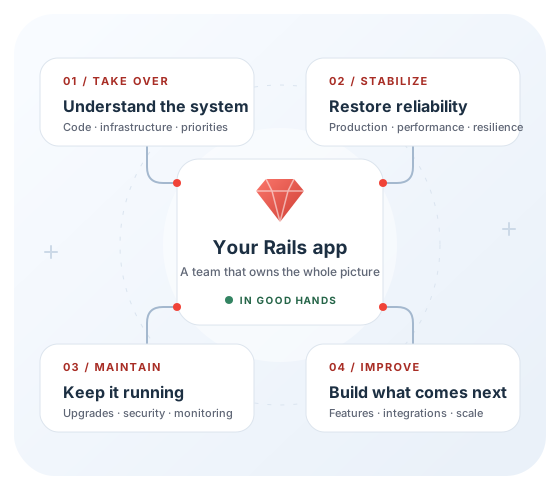
Start with what your application needs today. Build a long-term plan around your customers and business priorities.
Understand your codebase, infrastructure and business priorities. Map the risks and agree on a practical handover so you know who owns what.
Resolve production issues, slow queries, unreliable background jobs and fragile deployments. Give your team a dependable foundation.
Keep Ruby and Rails up to date, monitor the application and look after security and integrations. Stay ahead of problems with ongoing technical ownership.
Ship new features, modernize the architecture and develop the web or mobile experience. Help your product evolve as your business grows.
Application ownership includes ongoing development. We can improve performance, upgrade dependencies, maintain infrastructure, connect payment and accounting systems, and ship new web and mobile features around your Rails backend.
See how we restored a stalled background queue and eliminated recurring Heroku errors for ShopWired.
Read the case studySee how we redesigned Worship Online's Rails application with zero downtime and preserved its mobile integrations.
Read the case studyRead our founder's experience upgrading Ruby and Rails in an existing application, including dependencies and deployment challenges.
Read the upgrade articleWork with existing products
A takeover is more than a technical review. These existing client stories show how we helped live applications keep moving after a handover or through complex changes.

We took ownership of an existing legacy Rails application, added automated tests and delivered Stripe and ACH payments while improving stability and performance.
Read the takeover story
We gradually redesigned an existing Rails product while keeping it available and preserving its existing mobile integrations.
Read the long-term ownership storyA staged migration replaced Paperclip with ActiveStorage while keeping uploads and public media available during the transition.
Read the production migration storyBefore we take over
You can bring us the problem. We'll help you understand what the application needs and take responsibility for the next steps.
Yes. We specialize in taking over existing Rails applications, including projects where the original developer or agency is no longer available. We start by understanding the codebase, infrastructure, and business priorities.
We work with the repository, documentation, and access you have, identify missing information, and agree on how to recover it. If the outgoing developer is available, we coordinate the handover with them.
No. Bring us the problem and what it means for your business. We investigate the application, identify the technical causes, and agree on priorities with you. You do not need to turn every concern into a developer ticket or manage the technical solution yourself.
Whether the issue is recurring production failures, slow development, or an integration that no longer works reliably, we turn the findings into a practical plan with clear responsibilities and next steps.
We start with what already works and favor targeted fixes, gradual upgrades, and incremental improvements. A takeover does not require a rewrite. If a larger change is justified, we explain the tradeoffs and agree on the approach with you first.
Our work can include local refactoring, staged migrations, and interface improvements that preserve the application your customers already use.
It can include Ruby and Rails upgrades, dependency updates, production fixes, performance improvements, background jobs, monitoring, security, infrastructure, and integrations. We also build new features, prioritizing the work around your application’s condition and business goals.
We agree on the scope, priorities, and communication rhythm so maintenance and product development move forward together.
Not necessarily. We discuss the application, priorities and expected workload before recommending a focused takeover, ongoing maintenance or maintenance with development.
We will explain the proposed scope and engagement terms before work begins. The first conversation does not commit you to a full development contract.
It depends on the size and condition of the application, the support coverage you need and whether you also want new development. We can discuss an appropriate scope after learning about your situation.
Rather than quoting an invented fixed price, we clarify priorities, expected workload and working arrangements before proposing an engagement.
We start by understanding the impact, available monitoring and recovery options. As part of the handover we agree on incident contacts, responsibilities and response expectations.
Monitoring and around-the-clock engineer availability are different services. Any required coverage and response hours should be explicitly agreed rather than assumed.
We discuss what the product does, what is worrying you, who currently maintains it and what needs attention first. We then suggest a sensible next step, such as a focused technical review or a handover plan.
You do not need to grant access or prepare a full technical audit before the introductory conversation.
Yes. We can bring Rails expertise and technical ownership to support your existing team. We agree on responsibilities, coordinate changes, and help with difficult parts of the application while your team continues its work.
This can include upgrades, performance work, integrations, architecture decisions, and coordination with teams building other parts of the product.
We begin with your business priorities, then review the codebase, infrastructure, deployments, tests, and integrations. We map the risks, agree on a handover and the first priorities, and add test coverage where needed before making changes.
The first plan addresses urgent production issues and identifies the maintenance, upgrade, and feature work needed to keep the product moving.
Tell us what the application does, who currently maintains it, and what is most urgent. Share the repository, documentation, and infrastructure information you have when we agree on the review. You do not need to prepare a technical audit before talking to us.
Your application. A clear next step.
Tell us where the project stands today. We'll help identify the risks, priorities and a practical way to take it over.
