
Excursus
A few days ago I met a friend of mine. He had several questions about me and my experience. Almost all related to work I’d done recently. Although the questions covered various topics, I caught myself giving almost the same answer to all of them. It sounded like “Use dry-struct”. After that, I remembered I’d told similar stories to other people before. That made me very surprised and anxious because I realized how important and useful this tool is. Unfortunately, some of my friends don’t even understand why this tool exists at all.
In this post, I’m trying to reveal these questions and answers for people seeking the same information as my friend. I also set a goal to show what problems dry-struct actually solves for people who don’t understand its motivation. I want to show why this tool is very important and why it’s a step forward to a much more comfortable development process in the Ruby world.
Questions and answers
1. Andrei, I’ve heard you have experience with GraphQL. But what is your attitude to it? I prefer JSON API and don’t see GraphQL’s benefits.
Well, first of all, before comparing them, one should understand that JSON is just a format that specifies data. And usually this data is supposed to go from one “program/service/server/process/whatever” to another “program/service/server/process/whatever”. Let’s agree that “program/service/server/process/whatever” is a black-boxed service that can be either a back-end or front-end process and from now on we’ll call it a process.
Note, processes can be written in different programming languages as JSON is language-agnostic. Basically, this is just a set of rules that specify data going from Process A to Process B (more about JSON is in rfc7159):
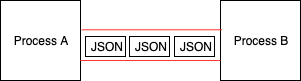
The red pipe in the picture above is a transport protocol responsible for data delivery. And inside this pipe, data is exchanged in JSON format. That’s it, JSON is just a properly formatted string, nothing more. Note, the protocol can be HTTP, RPC, AMQP, etc., and even just a method call inside the same process!
But before sending this string, a process needs to build it from objects residing in its memory. That action is called serialization. Moreover, a process that receives the data needs to rebuild corresponding objects in its memory. That action is called deserialization. Fortunately, for these actions, there are ready tools for almost all programming languages. Ruby and JavaScript are not exceptions here.
Unfortunately, properly serialized JSON doesn’t guarantee correct functioning of the process that deserializes it. Consider the following scenario. There is JSON data {title: "A post", body: "Some text"}. It’s good now for both processes: a sending process freely serializes it and a receiving process freely deserializes it. The processes themselves are working properly in integration, i.e. they are speaking the same language. Now, something changes on the sender side and the “title” field gets renamed to “name” spontaneously. With dynamic programming languages, a spontaneous change like that happens often, especially when the data is generated by some “magic” (hello, Ruby!). So the data structure implicitly changes to {name: "A post", body: "Some text"}. Now, what happens on the receiving side if these changes are not aligned? Of course, it fails. In the case of JavaScript, it processes the data improperly, showing an empty title instead of the expected “A post” in the UI. In any case, an innocent change introduces a bug.
How to prevent this issue? Manual testing? For sure, it’s possible to test everything manually. Whenever something changes, someone needs to run the corresponding processes and see if they work in integration. It may be OK if there are only two processes as in a web application with a Ruby back-end and a JavaScript front-end. It’s not a problem to open a browser and click around. But even that doesn’t guarantee there is no regression. Usually, there are some tricky scenarios or less-used places that are easy to forget, especially when there are missing testing scenarios. It’s easy not to spot a tiny thing in the UI that at first glance looks correct, but in fact, it’s wrong. Therefore, someone needs to read the code of the receiving processes and rule out use of the old name in all places.
If there isn’t much code and there aren’t many processes, this may be acceptable. But what if there are many processes? For example, in addition to our web UI, there are iOS and Android apps, with hundreds of versions, etc. And for each process, there is a separate responsible person/team. Then this easy regression check turns into a painful, lengthy activity. It leads to unnecessary communication and monkey business in the form of manual testing.
Eventually, manual testing doesn’t guarantee anything, because there is always a chance to miss something. Remember, the change in the example above happened spontaneously. Nobody knows about this change in the data at all! It’s easy to miss the bug and deploy to production without manual testing.
This is a typical case in the Rails world: a field gets renamed on a table, the unit tests are run and green, the code is read on the back-end side, and it’s guaranteed that nothing uses the old field on the back-end side. Deploy to production, open a browser, and oops :(
Integration tests would solve this issue if they had covered the code related to the change. This is a much more powerful approach and carefully written scenarios may solve the issue entirely. There are downsides of integration tests, though. First, they run too slowly. That’s why they may impact the development cycle. Second, they have a high cost in maintenance, CI time and implementation. Despite these obstacles, this is a very important part of an application with production deployment. It helps to make code changes confidently without harming the business.
But it’s possible to reduce the cost. If the processes communicated with each other through a contract, its violation would mean that integration is broken immediately:
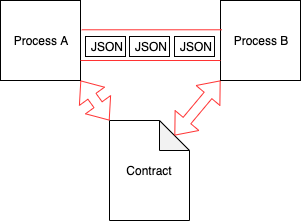
A contract here is some specification that’s understandable for both processes. It is supposed to fail instantly if the data doesn’t correspond to the contract during serialization or deserialization.
And here GraphQL comes into play. The point is that it has an implementation of a contract like that out of the box. It’s called “schema” there. It’s not possible to generate or receive data that doesn’t correspond to the schema. If the schema takes part in the unit tests, smoke testing is enough to make sure the integration works. And these tests are much cheaper.
This is not the only thing GraphQL solves out of the box. The schema is actually a set of all possible fields connected with each other. All the charm of GraphQL is that a receiving process can specify only the data it needs, no less and no more. And for all of that, there is only one endpoint instead of a forest of REST endpoints with weird names.
In my opinion, the winner is GraphQL here. It’s highly recommended for a sustainable, relatively big application. But for an MVP or PoC it may be redundant.
One might argue there are other commonly accepted ways to build a contract like that: Pact, JSON-schema, Swagger, and others. But they are subtly different from GraphQL. They are fixing the problem with JSON by adding one more complex technology to an already complicated stack. With GraphQL we have just one technology (not an easy one, though) that has everything necessary built-in.
For those who are convinced this is a technology worth looking at, there is an official place to start with.
Ok, but how does all of that relate to dry-struct? It turns out, a structure defined with dry-struct is a schema as well. It has fields with known types and connections between them, similar to GraphQL. It’s easy to serialize data into and deserialize from JSON.
This ultimately means dry-struct can be used in the same way as GraphQL for communication between processes. But with one caveat. Both ends should be written in Ruby. This way it would be possible to share dry-struct between sending/receiving processes, so that the transmitted data can be easily validated against the schema. Otherwise, we would need to synchronize a dry-struct schema between the place where it’s defined (in Ruby, of course) and a place that cannot reuse Ruby definitions. To implement this kind of synchronization, there should be a tool that transforms the dry-struct schema to a commonly used format that the other language supports.
Briefly speaking, GraphQL and dry-struct are tools that allow you to define a strict API between processes. With a strict API it’s easier to maintain the code and add new functionality. By strict I mean instant feedback about whether a change is possible in the code.
Now, consider there is only one Ruby process and internal method calls are used for data interchange. This situation is possible when a monolithic application is split into isolated modules that communicate via some “remote” protocol. In this case, a structure specified by dry-struct can be used as an API schema and a contract, and JSON can be used as a data transport format.
This is how it was implemented on a project from my experience:
- the dry structs are defined in a “repository1”
- “repository2” and “repository3” are just Ruby applications having “repository1” as a dependency, so that any change in the “schema” should be aligned in these repositories
- for convenience, all the “repositories” are kept in one git repository, so that:
- it’s easy to grep all the code at once and spot the places that require changes after a schema change
- no need to update dependencies manually in “repository2” and “repository3”.
But this is not all. If we picture just one Ruby process that calls only internal methods, dry-struct can be used as a value object. And again, as the structs are strict, we can talk about a reliable internal API. This is almost the same reliability that typed languages have.
2. What’s your preference for validating, preparing, and processing parameters coming from another process?
dry-schema is my leading preference here. It’s like dry-struct, has the same base that’s dry-types, has the same philosophy, but has a bit prettier DSL and API for validating params. Also, it’s easier for beginners.
I’m not a fan of keeping validations and callbacks on the model layer. Models can be used in different contexts that don’t need some of the callbacks or validations. So, it’s reasonable to define callbacks and validations inside these contexts instead of having spaghetti in one place. However, it’s reasonable to leave some validations on the model layer if they are true in all contexts. If we follow this rule, the code becomes easier to maintain and extend.
Check out this snippet to feel the idea:
PostSchema = Dry::Schema.Params do
  required(:title).filled(:string)
  optional(:body).filled(:string)
end

class CreatePostOperation
  def initialize(params)
    @params = PostSchema.call(params)
  end

  def peform
    raise ParamsError.new(params.errors.to_h) unless params.success?
    Post.create(params.to_h)
  end
end
The PostSchema is a contract between the receiving process and another process that sends the params. This contract specifies a set of rules such as:
- required and optional fields
- types of these fields
- automatic coercion of the given parameters according to the specified types
- if a parameter has a wrong type, or a value that’s impossible to typecast to the specified type, it’s considered a validation error.
Note, besides parameter validation, we also get manageable typecasting for free. By manageable here I mean an official possibility to add custom coercion rules or types without monkey patches. Keep in mind, Rails doesn’t have this possibility.
The CreatePostOperation is supposed to be used in a controller responsible for handling requests from other processes. Its implementation is simplified a lot here just for the sake of providing the idea. In reality, an operation like that has more things to take care of, such as:
- open DB transaction or not in
#perform - exit softly without exceptions providing an interface to fetch the errors
- bypass errors from the model layer. Remember, the
Postmodel above can still have validations or there may be constraints at the DB level. - catch particular exceptions and extract errors from there to expose them through the interface similar to model validations
- other things.
3. I’m familiar with dry-struct but it cannot serialize data from my objects. How do you serialize into dry-struct?
That’s true. dry-struct doesn’t have this functionality out of the box. But this is not a big deal as it’s easy to implement:
class BaseStruct < Dry::Struct
  def self.to_hash(object, type = self)
    type.schema.each_with_object({}) do |key, res|
      name = key.name
      attr = key.type
      if array?(attr)
        values = ::Array.wrap(object.public_send(name))
        res[name] = values.map { |value_item| serialize(value_item, attr.member) }
      elsif bool?(attr)
        value = object.public_send("#{name}?")
        res[name] = value
      else
        value = object.public_send(name)
        res[name] = serialize(value, attr)
      end
    end
  end

  private

  def serialize(object, type)
    complex?(type) ? to_hash(object, type) : object
  end

  def complex?(attribute)
    attribute.respond_to?(:<) && attribute < BaseStruct
  end

  def bool?(attribute)
    attribute.primitive?(true)
  end

  def array?(attribute)
    attribute.primitive?([])
  end
end

class Types
  include Dry.Types()
end

class PostStruct < BaseStruct
  attribute :title, Types::String
  attribute :body, Types::String.optional
end
The main function here is BaseStruct.to_hash as you’ve probably guessed. It’s just a recursive function that traverses all the defined attributes. Just start using it: PostStruct.to_hash(Post.last).to_json. Pay attention, the object being serialized should define all methods that are specified on the struct. In this example, there are title and body attributes defined on the struct, so that the Post instance should respond to both methods and return values with the specified types.
Note, a complex attribute should inherit from BaseStruct like that:
attribute :metadata, BaseStruct do
  attribute :writer_id, Types::Integer
  attribute :created_at, Types::Time
end
To get the whole picture check out the example of how to deserialize:
PostStruct.new(JSON.parse(params))
Also, one more piece of advice for people who have already tried dry-schema or dry-struct. At first glance, they may look scary because of the diversity of types. Types there don’t all exist in the global scope as they do in Ruby. For example, in Ruby there is String and that’s it, it’s String everywhere. In dry-struct/dry-schema types relate to groups: nominal, strict, coercible, params, json, maybe. More about this is here. The difference between them is how strict they are and whether automatic typecasting is possible.
For JSON serialization and deserialization we need strict and coercible types. But not all default dry-struct types satisfy these requirements. For instance, there is no strict and coercible Date out of the box. Fortunately, we can combine them: Date = Strict::Date | JSON::Date. And if we put this code under the Types class above we can come up with the following elegant code:
class Types
  include Dry.Types()

  Date = Strict::Date | JSON::Date
  Symbol = Strict::Symbol | JSON::Symbol
  Time = Strict::Time | JSON::Time
  Decimal = Coercible::Decimal
end
And now all types under the Types:: space are strict and coercible. We shouldn’t worry about which group to take a type from when specifying an attribute.
4. Ruby debugging is a pain. Can you recommend something to reduce the time spent on that?
Of course, I can. Use dry-struct! Seriously, strictly defined structures in the code make it much more readable, which reduces debugging time drastically. Which type is used and where becomes clear almost immediately after the first look at the code. If the signature of the methods receiving these structures is documented, we get an almost statically typed language out of the box. So we benefit from both worlds: dynamic and static.
Example of method signature documentation in YARD format:
# @param post_params [PostStruct]
def publish(post_params)
By the way, documenting just method signatures is good. But documenting methods themselves from a business point of view also brings a lot of benefits. If you still don’t document your code, I invite you to start doing that. You will see how you become a better developer.
Conclusion
The Dry-rb ecosystem is huge. In this post, we’ve touched only parts of it: dry-struct, dry-schema, and implicitly dry-types. I hope you’ve seen the benefits these tools bring to Ruby world. In short, they borrow a missing part from statically typed programming languages - types. That makes programming in Ruby much more comfortable and confident. As a result, it reduces pain in terms of bugs and debugging time.